

The headlines this week are about volume. For someone choosing a name, the more useful question is narrower: which of these endings will you actually be able to buy, roughly when, and should any of it change what you register now? This post answers that from ICANN's own files, which we downloaded and recounted.
What is on the new gTLD list for 2026?
The application window ran from 30 April to 12 August 2026. ICANN showed the first full picture on Reveal Day, 7 October, then let applicants stuck in a crowded fight switch to a backup string. The String Confirmation Day announcement on 17 November froze the result.
| Measure | Reveal Day, 7 Oct | String Confirmation, 17 Nov |
|---|---|---|
| Applications | 1,615 | 1,606 proceeding |
| Brand applications | 333 | 333 |
| Contention sets (strings with 2+ applicants) | 263 | 226 |
| Applications in contention | 891 (55%) | 705 (44%) |
| Switched to a replacement string | n/a | 152 |
Two more numbers put the round in context. North America filed 864 of the Reveal Day applications and Europe 506, according to ICANN's Reveal Day release. The 2012 round, the only previous one, drew 1,930 applications and ended with 1,241 new endings in the root, per ICANN's 2012 programme statistics. So this round is smaller, but not by much.
Each application cost USD 227,000 in evaluation fees alone, as set in Module 1 of the 2026 Applicant Guidebook. Nobody spends that on a string they expect to sit idle, which is why the contested ones are worth reading closely.
The most contested strings, and why AI dominates them
ICANN publishes the contention sets as a CSV. We counted the 17 November file applicant by applicant. Nineteen strings have six or more applicants each.
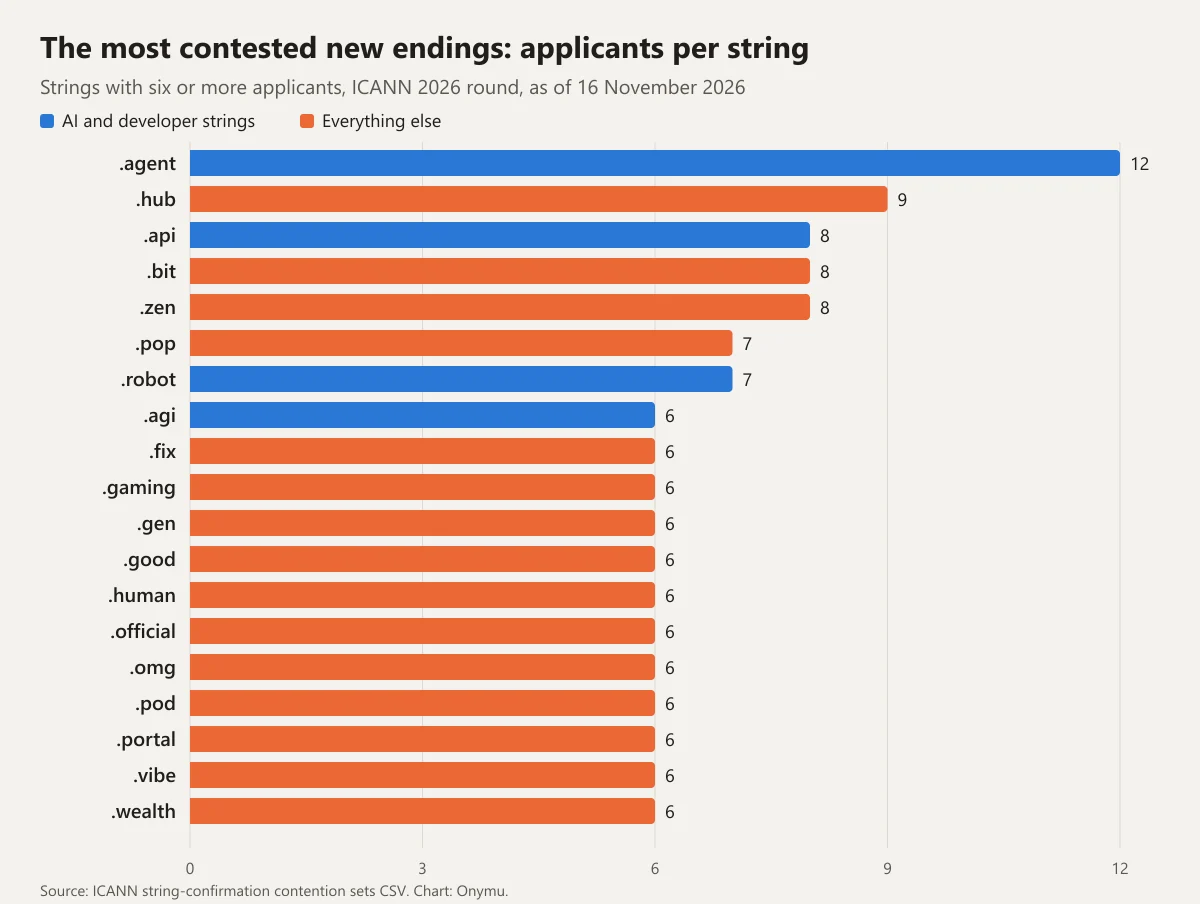
The top of the list reads like a description of the 2026 software market. .agent leads with 12 applicants, .api has 8, .robot 7 and .agi 6. Below the chart line the pattern continues: .mcp has 5 applicants, .gpt, .model, .skill and .voice have 3 each, and .llm and .agentic have 2.
Who is applying matters as much as how many. An entity named OPENAI OPCO, LLC appears in eight contention sets: .agent, .agi, .asi, .gpt, .mcp, .model, .skill and .voice. Charleston Road Registry Inc., which IANA lists as the registry behind .app and .dev, is in the .agent, .api and .mcp sets. When the companies building AI products and the registry that made .dev a developer default both want the same ending, expect the auction to be expensive.
The other end of the market is portfolio registries. Link Freedom Group Ltd appears 96 times in the contention file, XYZ.COM LLC 69 times and Radix Technologies 40 times. These are operators betting on many generic words at once. Those three alone hold 205 of the 705 contested applications.
How contested strings get decided
A contested string has one eventual operator, at most. The guidebook's contention module allows two ways to settle it: Community Priority Evaluation, which only community applications can use, or an ICANN auction. Private auctions and joint ventures between applicants are "strictly prohibited" this time.
The ICANN auction is ascending-clock and second-price, so the winner pays roughly what the runner-up was willing to bid. For a founder this has one practical consequence: the operator of .agent or .api will start life having paid a large sum for the right, and will want it back. Our expectation, not a rule anyone has published, is that the short, obvious names under those endings will be priced as premiums from day one.
When could you register a domain on these new endings?
Not soon. As of 21 November 2026, ICANN has published dates only for the early steps:
| Step | Status |
|---|---|
| Community input and objections | 17 Nov 2026 to 16 Mar 2027 |
| String evaluation | Started 17 Nov 2026, expected to take 180 days |
| Prioritization draw (processing order) | First half of 2027, no date |
| Contention resolution and auctions | No date |
| Contracting | Within 90 days of an invitation |
| Delegation to the root | Within one year of signing the registry agreement |
The guidebook itself says the "estimated duration to complete onboarding and delegation will be provided at a later time". The best guide is the last round. Applications closed on 29 March 2012 and the first four new endings were delegated on 23 October 2013, about 19 months later. Even then, ICANN noted the registries still had trademark-protection steps to finish before anyone could register.
Apply the same 19 months to a 12 August 2026 close and the first delegations land around March 2028. That is arithmetic, not a forecast. The contested strings also have to get through an auction first, and ICANN has not dated a single one yet.
One more delay is easy to miss. The guidebook warns that networks "may not immediately fully support new top-level domains, even when these domains have been delegated". Email validators and sign-up forms that reject unfamiliar endings are a real cost for a brand-new extension.
Should a new gTLD change the name you pick today?
No. Pick the name now, on an extension that exists, and treat a matching new ending as an optional extra in 2028 or later. Three reasons:
- Timing. A company being named this month will have shipped, raised and possibly renamed before .agent takes its first registration.
- Price. The endings founders want most are the ones going to auction, which points to premium pricing on exactly the short names you would want.
- Substitutes already exist. Most of the meaning in the contested strings is available on endings you can register this afternoon.
That last point is where our own data helps. Onymu checks availability across 1,400 live extensions, and every ending in the right-hand column below is registrable today:
| Applied for in 2026 | Applicants | Live alternatives today |
|---|---|---|
| .agent, .agi, .gpt | 12, 6, 3 | .ai, .bot, .agency |
| .api, .mcp, .stack | 8, 5, 4 | .dev, .tools, .codes, .build |
| .robot, .robotics | 7, 4 | .bot, .tech, .systems |
| .hub, .portal, .platform | 9, 6, 2 | .network, .zone, .digital |
| .lab, .labs | 5, 5 | .studio, .build, .software |
| .crypto, .wallet, .coin | 5, 4, 3 | .finance, .money, .capital |
| .gaming | 6 | .games, .game |
Which of those is right depends on the name. Our guide to AI domain extensions and their alternatives compares the AI-flavoured options on price and perception, and whether TLDs matter for SEO covers the ranking question.
The one case where it is worth planning ahead
If your company name is itself one of the contested words, or a brand that a new ending would describe exactly, keep a note of the string and watch for its launch. In the 2012 round, each new ending opened with a sunrise period reserved for trademark holders before anyone else could register, so a registered trademark is what got you in early. ICANN has not yet published how launches will work for the 2026 strings, but the same pattern is the safe assumption. Our guide to trademark risk for domain names explains what counts.
Frequently asked questions
Where is the full new gTLD list?
ICANN's Application Publication and Statistics site lists every application and can export it. The contention-set CSVs cover only strings with two or more applicants, so single-applicant strings appear on the APS site alone.
Can I register a .agent or .api domain now?
No. They are applications, not live extensions. No registrar can sell them until a registry wins the string, signs a contract with ICANN and launches. Treat any "pre-registration" offer as a paid waiting list with no guarantee.
How much did it cost to apply for a new gTLD in 2026?
The evaluation fee was USD 227,000 per application, before legal, technical and auction costs. Qualifying applicants in ICANN's Applicant Support Program paid a reduced fee.
How many new gTLDs were applied for in 2026?
ICANN counted 1,615 applications on Reveal Day and 1,606 still proceeding on 17 November 2026. Many applications target the same string, so there are fewer distinct endings than applications: ICANN's statistics page counts 1,127 unique strings.
What to do next
Settle the name on what exists today. Run your shortlist through Onymu's domain search, which checks all 1,400 live extensions at once, and if the obvious endings are gone, the name generator will find variations that are still free. When the first of these new endings launches, we will cover it here.
