

Most naming guides stop at "brainstorm and check the domain". The hard part is everything after the brainstorm, because that is where good-sounding names die: the .com is parked, the Instagram is taken, or a company in your category registered the word in 2019. This guide puts the checks in the order that wastes the least time, and shows a real run through them.
Step 1: How to name a startup starts with a brief, not names
A naming session without a brief turns into a vote on taste. Write one paragraph that answers four questions:
- What do you do, in one sentence a customer would use?
- Who decides to buy, and what do they already call products like yours?
- How should it feel: serious, friendly, technical, premium?
- Where will it be said out loud: sales calls, podcasts, a shop counter?
The last question matters more than it looks. A name that is only ever seen can be clever. A name that is heard has to survive being spelled from memory.
Step 2: Choose the type of name first
The single most useful decision in naming is the type of name, because it decides how easy the rest will be. The USPTO groups marks on a spectrum of strength, and the same spectrum predicts how crowded the domains are.
| Type | Example | Trademark strength | Domain and handle odds |
|---|---|---|---|
| Invented (fanciful) | Exxon, Pepsi | Strongest | Good if truly new, but popular-sounding inventions are taken |
| Real word, unrelated meaning (arbitrary) | Apple for computers | Strong | Poor for single words, better as compounds |
| Suggests a quality (suggestive) | Coppertone | Good | Reasonable |
| Describes the product (descriptive) | "Invoice Hub" | Weak, registrable only in some cases | Very poor |
| Generic | "Invoices" | Not registrable | Gone |
The USPTO says descriptive marks are registrable "only in certain circumstances", and generic terms are not registrable at all. Descriptive names feel safe because they explain themselves, but they are the weakest to protect and the hardest to find a domain for. Aim for suggestive or arbitrary, and treat invented names with care: our check of 20 names found that invented-sounding names like quorra and lumora were taken on Instagram 10 times out of 10.
Step 3: Generate widely, then cut hard
Aim for 50 to 100 candidates before judging any of them. Mix sources: words from the brief, their synonyms, metaphors from a different field, and blends. A name generator is useful here because it only returns names with at least one free domain, which saves you from shortlisting names that are already dead.
Then cut with three cheap tests that need no tools:
- The say test. Say it out loud to someone who has not seen it. Can they repeat it?
- The spell test. Say it again. Can they type it correctly first time?
- The meaning test. Search the word with "meaning" and check it in the languages of your first markets.
Pronounceability is not just taste. In a 2006 Princeton study published in PNAS, Adam Alter and Daniel Oppenheimer found that shares in companies with easy-to-pronounce names outperformed hard-to-pronounce ones shortly after listing. The authors were clear that the effect faded over time, and nobody should pick a name for its stock price, but the result shows how quickly people judge an unfamiliar name on ease alone.
Step 4: Check availability in the right order
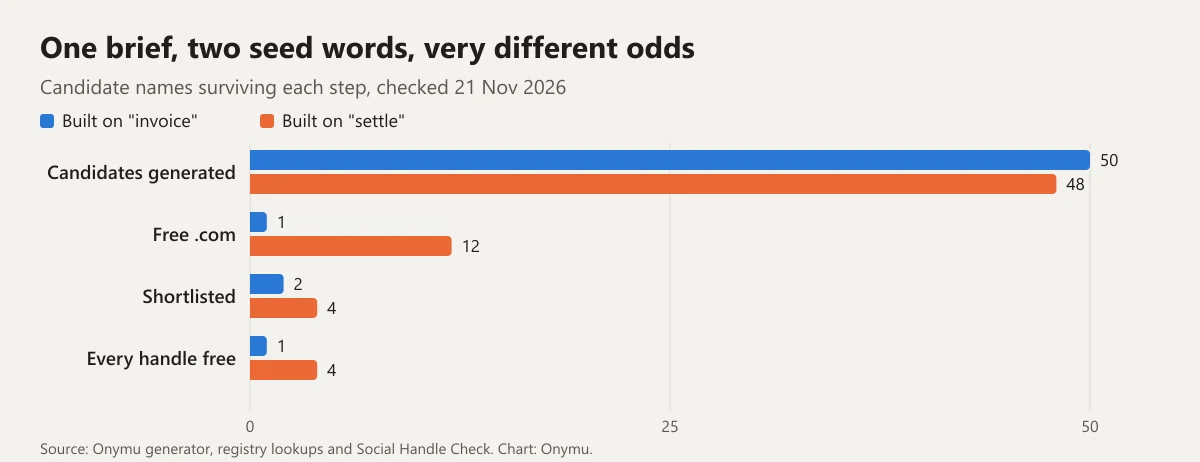
We ran one brief through this step: an invoicing tool for freelancers. Here is what happened on 21 November 2026, using Onymu's generator, domain search and Social Handle Check, with every domain result confirmed live at the registry.
| Stage | Built on "invoice" | Built on "settle" |
|---|---|---|
| Candidates generated | 50 | 48 |
| Free .com | 1 (2%) | 12 (25%) |
| Shortlisted | 2 | 4 |
| Free on Instagram, TikTok, YouTube, LinkedIn and GitHub | 1 of 2 | 4 of 4 |
The keyword names were almost all variations of invoicehub, invoicelab and invoicebox, and their .com versions were registered. One of the two we shortlisted, invoicenest, still had a free .io but was already taken on Instagram and as a LinkedIn company page. The evocative word did far better: settlehive, settlebench, sharesettle and oursettle each had a free .com and every handle we checked.
The order matters. Check the domain and the handles together, before anyone on the team gets attached. If you need a reason to accept something other than .com, our piece on whether you need a .com covers when it matters and when it does not.
Step 5: Search the trademark registers
A free domain says nothing about whether you can use the name. Search the registers in the markets you will sell in, for the exact name, close spellings and similar-sounding words, in the classes that cover your product:
- United States: the USPTO's Trademark Search, which replaced the old TESS system on 30 November 2023.
- European Union: EUIPO's eSearch.
- Worldwide: WIPO's Global Brand Database.
A match in an unrelated class is often fine. A match in your class with a similar-sounding name is not. Our guide to trademark risk for domain names explains how to read the results, and for anything you will raise money on, a short opinion from a trademark lawyer is cheap insurance.
Step 6: Live with the finalists for a week
Put the last two or three names into real contexts: an email signature, an app icon, a search result, a social profile. Onymu's brand preview draws a name into mock-ups of all of these at once. Names that looked equal on a whiteboard rarely look equal on a phone home screen. Expect the strangest-sounding finalist to grow on you, which is the pattern we described in why the best startup names sound weird at first.
Step 7: Secure everything on the same day
Once you decide, register the domain, the obvious alternative extensions you care about, and every social handle, in one sitting. Names you have searched for are not reserved for you, and the gap between deciding and registering is where people lose them.
Frequently asked questions
How long should a startup name be?
Short enough to say in one breath and type without checking. Two syllables to four is the comfortable range. Length matters less than whether the name survives the say and spell tests.
Should the startup name describe what we do?
Usually not. Descriptive names are the weakest to protect and the hardest to find a domain for, and they box you in if the product changes. A name that suggests a quality is a better compromise.
Is it a problem if the .com is taken?
Not always. It depends on who owns it and what is on it. A parked .com is a price problem. A .com running a company in your field is a confusion and trademark problem, and a reason to keep looking.
Can I use AI to name my startup?
Yes, for the generating step. Language models are good at producing candidates but, on their own, cannot see live availability, so every name they suggest still has to go through steps 4 and 5.
What to do next
Start with the brief, then run your seed words through the name generator, which only returns names with a free domain, and put the shortlist through Social Handle Check before you take a vote.
